The Silence of the Silicates: The Search for Dark Life on Rogue Planets
Beyond the light of any sun, billions of 'orphan' worlds may harbor the universe’s most resilient ecosystems.
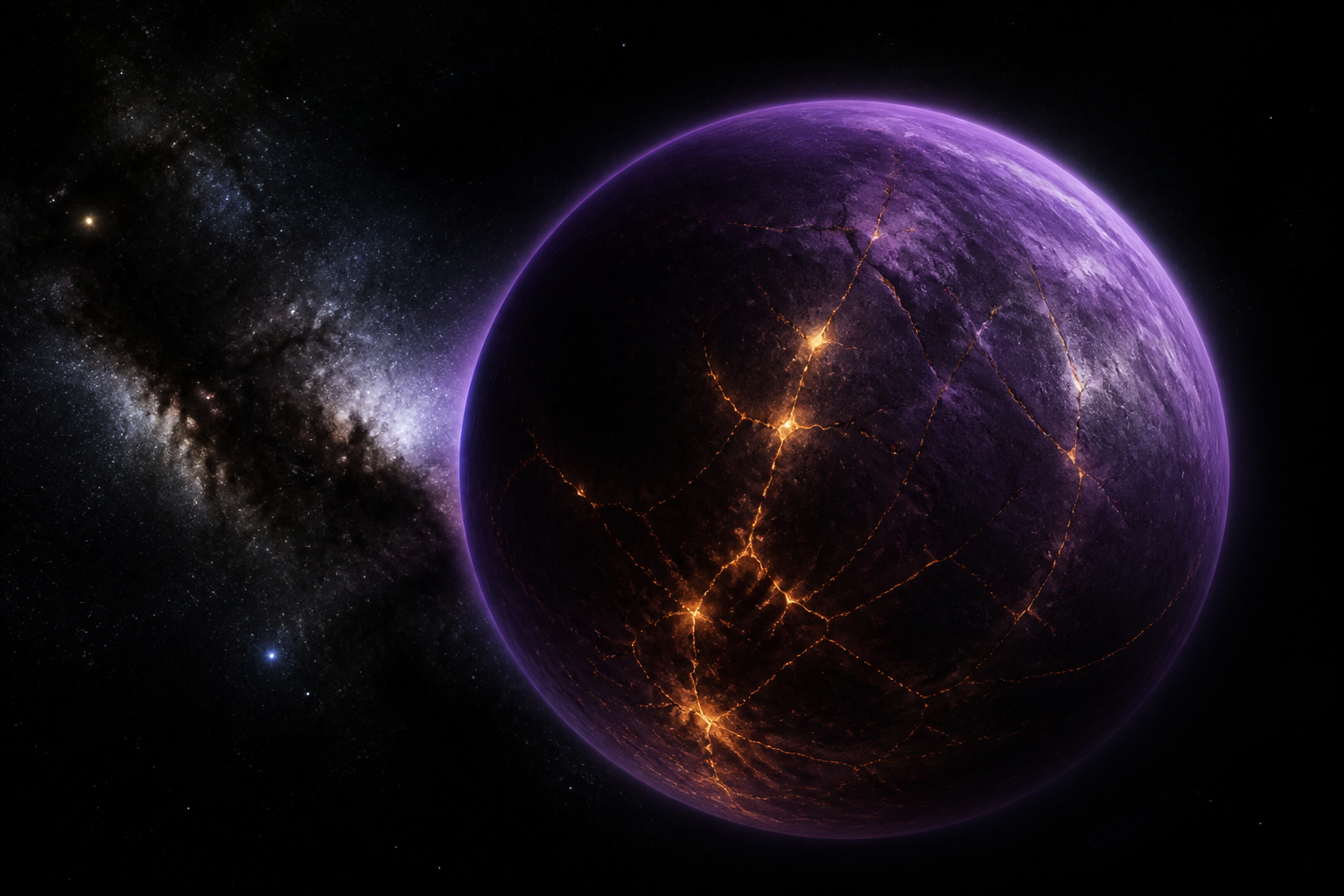
The Loneliest Voyagers
Imagine a world where the sun never rises. Not because of a long winter or a peculiar axial tilt, but because there is no sun at all. For decades, our search for life in the cosmos has been blinded by a solar bias. We have looked for 'Earth 2.0'—planets orbiting G-type stars at just the right distance to keep water liquid. But there is a silent majority in the Milky Way that we are only beginning to comprehend: rogue planets.
These celestial orphans, ejected from their home systems by gravitational skirmishes during their infancy, drift through the interstellar void. Bereft of starlight, they were once thought to be frozen, sterile husks. Recent modeling, however, suggests the opposite. Deep beneath thick layers of ice or dense hydrogen atmospheres, these worlds may be brewing the most stable biological experiments in the universe.
The Gravitational Pinball
How does a planet lose its home? During the chaotic formation of planetary systems, gas giants like Jupiter often migrate, throwing smaller terrestrial worlds into chaotic orbits. Through a process called gravitational scattering, these smaller planets can be whipped out of the system entirely, destined to spend eternity in the dark.
Research published by the University of Chicago suggests that there could be as many as two rogue planets for every star in our galaxy. If the Milky Way holds 100 billion stars, we are looking at a population of 200 billion lonely worlds.
The Thermal Blanket: Why They Aren’t Always Frozen
A common misconception is that a planet without a star must be a solid block of ice at absolute zero. Thermodynamics tells a different story. If a rogue planet is large enough and retains a thick primordial atmosphere—specifically one rich in molecular hydrogen ($H_2$)—it can trap the heat generated by its own internal radioactive decay.
"A hydrogen-rich atmosphere on a terrestrial-mass rogue planet can act as a high-performance insulating blanket, potentially keeping surface temperatures high enough for liquid water to persist for billions of years." — Dr. Dorian Abbot, Geophysical Sciences Researcher
This phenomenon, known as the Abbot-Switzer mechanism, posits that the high pressure of a heavy atmosphere prevents the oceans from boiling away or freezing solid, creating a sub-surface sanctuary fueled by radiogenic heating (the decay of isotopes like Uranium-238 and Potassium-40 in the planet's core).
Comparing Habitable Zones: Stellar vs. Rogue
| Feature | Circumstellar Habitable Zone | Rogue Planet 'Dark' Zone |
|---|---|---|
| Energy Source | Stellar Photons (Photosynthesis) | Radiogenic/Tidal Heat (Chemosynthesis) |
| Atmosphere | Nitrogen/Oxygen/CO2 | Hydrogen/Helium/Methane |
| Stability | Vulnerable to Solar Flares/Stellar Evolution | Highly Stable for Billions of Years |
| Visibility | High (Transit/Radial Velocity) | Extremely Low (Microlensing only) |
The Biochemistry of the Dark
If life exists on a rogue planet, it looks nothing like the verdant forests of Earth. Without photosynthesis, the food chain would likely begin with lithoautotrophs—microbes that 'eat' rocks. On Earth, we see this in the deep-sea hydrothermal vents of the Mid-Atlantic Ridge. These ecosystems thrive in total darkness, relying on chemical gradients to synthesize organic molecules.
On a rogue world, the entire biosphere would be 'deep-sea.' The lack of a star means there are no seasons, no volatile weather patterns, and no UV radiation to cause genetic mutations. This leads to a piercing evolutionary question: Does the extreme stability of a rogue planet lead to biological stagnation, or does it allow for the slow, methodical development of hyper-complex organisms?
Detecting the Invisible
Finding these worlds is the ultimate game of cosmic hide-and-seek. Because they emit no light, we rely on gravitational microlensing. When a rogue planet passes directly in front of a distant background star, its gravity acts like a magnifying glass, briefly warping and brightening the star's light.
NASA’s upcoming Nancy Grace Roman Space Telescope is designed specifically to hunt for these fleeting flashes. By surveying the galactic bulge, astronomers expect to identify hundreds of Earth-mass rogue planets, providing the first census of the 'dark' population.
Is Our Solar System 'Weird'?
As we discover more about the frequency of planetary ejection, a provocative hypothesis emerges: perhaps life in the light is the anomaly. The vast majority of habitable real estate in the universe might not be on sun-drenched islands like Earth, but in the sprawling, quiet oceans of the interstellar void.
Living on a rogue planet would provide a strange form of safety. These worlds are immune to the death of their parent stars. While Earth will eventually be scorched as our Sun becomes a Red Giant, a rogue planet in the void will remain unchanged, its internal fires burning steadily for trillions of years. They are the ultimate survivors of the cosmos.
Summary of Findings
- Total Population: Estimated at 200 billion in the Milky Way alone.
- Survival Mechanism: Hydrogen atmospheres and radiogenic heat keep water liquid.
- Biological Potential: Chemosynthetic life forms similar to Earth's extremophiles.
- Future Missions: The Roman Space Telescope (launching mid-2020s) will be the primary tool for discovery.
FAQ
Can a rogue planet have a moon?
Yes. In fact, tidal heating between a rogue planet and a large moon could provide an additional source of energy to keep the planet's interior warm, much like the relationship between Jupiter and Europa.
How cold is the surface of a rogue planet?
Without an atmosphere, the surface would be roughly -270°C. However, with a thick hydrogen atmosphere, the surface temperatures could reach a balmy 20-30°C, despite being in the middle of interstellar space.
Could humans ever live on a rogue planet?
While we couldn't live on the surface due to crushing atmospheric pressure, the geothermal heat could theoretically power human colonies in subsurface bunkers. It would be a permanent 'night shift' existence.
Get the Digest
Sharp, original reporting in your inbox. One weekly email, no noise.
Frequently asked questions
- What is a rogue planet?
- A rogue planet is a planetary-mass object that does not orbit a star. They drift through interstellar space, having been ejected from their original solar systems by gravitational interactions.
- How can a planet stay warm without a sun?
- They stay warm through radiogenic heating (the decay of elements in the core) and insulation from thick atmospheres, often rich in hydrogen, which acts as a powerful greenhouse gas.
- How do we find rogue planets if they are dark?
- Astronomers use gravitational microlensing, observing how the planet’s gravity bends the light of a distant star as it passes in front of it.