The Silence of the Vault: The Neo-Monastic Turn in Office Design
As open-plan fatigue reaches a breaking point, architects are looking to 12th-century Cistercian abbeys to solve the 21th-century crisis of focus.
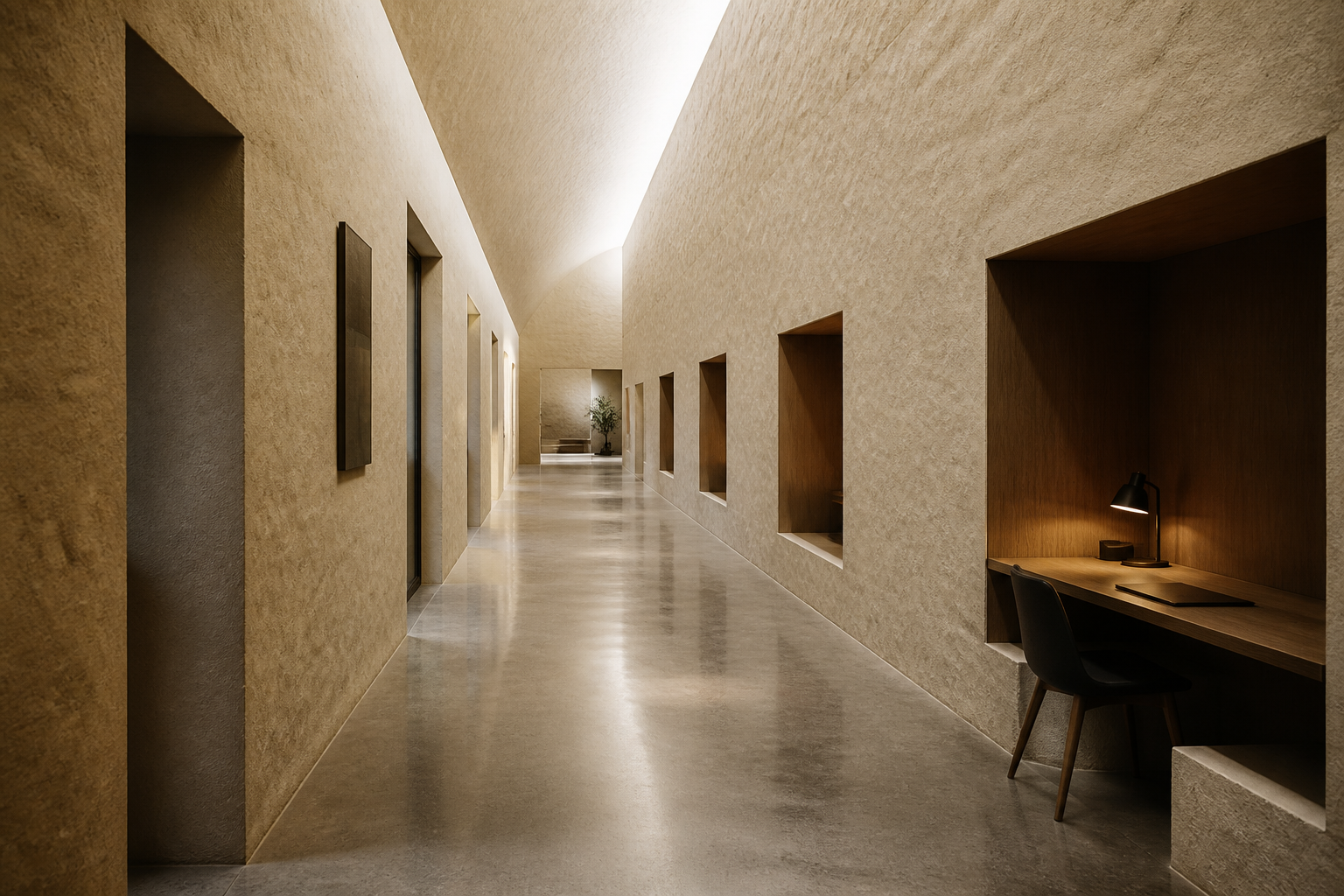
The Ghost of the Open Plan
For three decades, the gospel of the workplace was 'serendipity.' We were told that by tearing down walls, shattering cubicles, and forcing everyone into a sprawling, level sea of desks, the resulting 'friction' would spark innovation. Instead, it sparked a slow-motion collapse of the human attention span. The modern office became a high-decibel warehouse of distraction, where the ping of a Slack notification carries more weight than a focused hour of strategic thought.
Now, a quiet revolution is taking place in the studios of preeminent architects from Tokyo to Copenhagen. We are witnessing the Neo-Monastic Turn. Rather than looking to the tech campuses of Silicon Valley for inspiration, designers are looking backward—centuries backward—to the Cistercian abbeys of medieval Europe and the Zen temples of Kyoto. The goal isn't just to house workers; it is to protect their cognitive sovereignty.
Why is traditional office design failing?
The failure of the open-plan office is not merely an aesthetic grievance; it is a biological mismatch. Humans are social creatures, but we are also apex predators that require environmental security to enter a 'flow state.' In an open environment, the amygdala remains on high alert for peripheral movement and sudden noise. The 'Neo-Monastic' approach seeks to solve this by reintroducing spatial haptics: thick walls, heavy doors, and a transition from the profane (the street) to the sacred (the focused workspace).
"The most luxurious amenity in the 21st-century office isn't a barista station or a gym—it is the absolute, unyielding absence of other people's noise."
The Anatomy of the New Cloister
In the new design language, the 'campus' is being replaced by the 'compound.' Take, for example, the recent work of John Pawson or the Herzog & de Meuron extensions for research institutes. These spaces utilize the 'cloister'—a covered walkway surrounding an open courtyard—as their primary organizing principle.
This isn't just for aesthetics. The cloister provides three fundamental psychological benefits:
- Liminality: A physical space to transition from one mental state to another.
- Visual Continuity: A view of nature that is contained and predictable.
- Acoustic Shadowing: The use of heavy masonry to create 'dead zones' where sound cannot travel.
Contrasting Paradigms: Open Plan vs. Neo-Monastic
To understand the shift, we must look at the physical specifications. The Neo-Monastic office prioritizes 'mass'—a concept almost forgotten in the era of dry-wall and glass partitions.
| Feature | Open-Plan Model | Neo-Monastic Model |
|---|---|---|
| Primary Goal | Casual Interaction | Cognitive Focus (Deep Work) |
| Materiality | Glass, Steel, Drywall | Stone, Timber, Rammed Earth |
| Acoustics | Masking (White Noise) | Isolation (Physical Mass) |
| Visuals | High Transparency | Controlled Views / Framing |
| Desk Layout | Hot-desking / Bench | Private Cells / Carrels |
Materiality and the 'Sanctity of the Surface'
The tactile environment plays a significant role in the Neo-Monastic turn. There is an increasing move toward Monochromatism and Natural Textures. When every surface is tactile—honed basalt, reclaimed oak, or lime-wash plaster—the brain stops searching for visual novelty and begins to settle.
One emerging trend is the use of the Monastic Carrel. Originally used by monks to copy manuscripts, these built-in wooden niches are appearing in corporate headquarters in London and New York. Unlike the 1980s cubicle, which was a flimsy plastic divider, the modern carrel is a permanent architectural fixture, often built into the depth of the exterior walls.
The Cost of Distraction vs. The ROI of Silence
Critics often argue that Neo-Monastic architecture is an inefficient use of floor space. If you have thick walls and wide cloisters, you cannot pack as many 'heads' into a square meter. However, developers are starting to realize that the 'density-first' approach has diminishing returns. If a worker is only 40% as productive due to noise, the savings on real estate are illusory.
"We are no longer building for bodies; we are building for brains. Mass and weight return to architecture because they provide the stillness that glass cannot."
Case Study: The New Library as Work Prototype
The most successful implementations of this are not actually in offices, but in 'private libraries.' Projects like the Stadtbibliothek Stuttgart or the Crosby Street Studios demonstrate that when people are given high-ceilinged, acoustically dampened 'cells,' their output increases exponentially.
Key Design Elements of the Neo-Monastic Office
- The Atmospheric Threshold: A long, dark entry corridor that creates a 'sensory reset' before entering the main workspace.
- Thermal Mass: Using heavy materials to regulate temperature naturally, creating a more 'grounded' physical sensation.
- The Scriptorium: A designated room for zero-tech work, where devices are prohibited and only physical paper and pens are allowed.
- Refectory Dining: Moving away from the 'desk lunch' toward a single, long communal table in a separate hall, mimicking the monastic shared meal.
Is Privacy the New Luxury?
As we look to the future, the 'office of the future' looks remarkably like the monasteries of the past. In a world of total digital availability, the ability to disappear into a stone-walled room and think remains the ultimate competitive advantage. Architects are no longer striving for transparency; they are rediscovering the power of the wall.
Comparative Acoustic Performance
| Material | Sound Reduction Index (dB) | Psychological Effect |
|---|---|---|
| 10mm Toughened Glass | 32 dB | Constant visual distraction, auditory muffled |
| Standard Wood Stud Partition | 40-45 dB | Vulnerable to low-frequency thumping |
| 200mm Solid Masonry | 55-60 dB | Near-total isolation; sense of permanence |
| Rammed Earth (300mm) | 60+ dB | Organic 'deadening' effect; extremely grounding |
FAQ: Designing for Focus
Q: Isn't this just 'minimalism' under a different name?
A: While Neo-Monasticism shares an aesthetic with minimalism, it is functionally different. Minimalism is often about 'stripping away' for visual purity. Neo-Monasticism is about 'adding mass'—using weight, darkness, and enclosure to protect the user's attention.
Q: Does this design style work for collaborative teams?
A: Yes, but it separates the 'social' from the 'cerebral.' Instead of a constant buzz, it utilizes a 'Pulse' model: periods of deep, isolated work interrupted by intentional, high-intensity collaboration in a separate, dedicated 'Refectory' or 'Chapter House.'
Q: How does this impact employee well-being?
A: Studies suggest that reducing the 'perceived cognitive load' of an environment lowers cortisol levels. By removing the need to constantly filter out background noise and movement, the architecture does the heavy lifting for the nervous system.
Conclusion
The move toward Neo-Monastic architecture represents a maturation of our relationship with work. We have moved past the novelty of the 'fun' office and are entering an era of 'essential' architecture. By reclaiming the silence of the vault, we aren't just building better offices—we are building sanctuaries for the human mind.
“We are no longer building for bodies; we are building for brains, using mass to provide stillness.”
Get the Digest
Sharp, original reporting in your inbox. One weekly email, no noise.
Frequently asked questions
- What is the Neo-Monastic turn in design?
- It is a movement in architecture that prioritizes thick walls, acoustic isolation, and simple, heavy materiality—inspired by monasteries—to facilitate deep work.
- Why is it replacing the open-plan office?
- Open-plan offices fail to protect the user's focus, leading to cognitive fatigue and decreased productivity; Neo-Monastic spaces provide the necessary security for flow states.
- Which materials are characteristic of this style?
- Solid stone, rammed earth, heavy timber, and lime-wash plaster are preferred for their thermal mass and acoustic deadening properties.